You build an app on your laptop. It runs beautifully. You hand it to a teammate, or push it to a server, and suddenly it breaks — a missing library, the wrong language version, a setting that only existed on your machine. “But it works on my computer!” is one of the oldest, most frustrating sentences in software. Containers are the technology that finally put that sentence to rest.
A container is a way to package an application together with everything it needs to run — its code, its libraries, its settings — into a single, self-contained unit that behaves the same way no matter where you start it. Once you understand that one idea, a huge chunk of how modern software gets shipped and deployed suddenly clicks into place.
What a container actually is
A container is a lightweight, isolated package that holds an application and all of its dependencies. Think of it as a sealed box: inside is your program plus the exact versions of every tool, library, and runtime it expects. The box doesn’t care what’s outside it. Drop that same box onto your laptop, a colleague’s machine, or a server in a data center, and the program inside runs identically, because everything it relies on travels with it.
That word “dependencies” is the heart of it. Almost no program runs entirely on its own. It needs a specific version of a programming language, certain libraries, maybe a particular set of system tools. Normally, all of that has to be installed on the host machine and configured correctly — and that’s exactly where things go wrong, because no two machines are set up identically. A container sidesteps the whole problem by carrying its own dependencies inside, isolated from whatever happens to be installed on the host.
Here’s the key distinction from a regular install: when you install software the traditional way, it reaches out and mixes into the host system. When you run software in a container, it lives in its own little walled-off world, sharing the host only where it’s safe to do so. The host barely notices, and the container barely notices the host.
A container isn't a virtual machine
People new to this often picture a container as a tiny computer running inside their computer. It isn’t — that description fits a virtual machine, which is a heavier, slower thing. A container is far lighter: it shares the host’s operating system kernel instead of booting its own. We’ll touch on the difference below, and it’s worth a dedicated look once you’re comfortable with the basics, because the distinction explains why containers are so fast to start.
The shipping-container analogy
The name isn’t an accident. Before standardized shipping containers existed, loading a cargo ship was chaos: every item had a different shape, packed by hand, and unloading at the next port meant repacking everything for the next truck or train. Then someone had the idea of a standard steel box. Suddenly it didn’t matter what was inside — a crane, a ship, a truck, and a train all handle the box the same way, because the box has a standard shape.
Software containers do the same thing for programs. It doesn’t matter whether the box holds a website, a database, a background worker, or a tiny script — the system that runs containers handles every box the same way. Start it, stop it, move it, copy it. The standardized “outside” means the messy, varied “inside” stops being everyone else’s problem.
   Without containers              With containers
   ──────────────────              ───────────────
   "works on my machine"           same box, every machine
   manual setup per server         ship the box, just run it
   fragile, slow to move           standard shape, easy to move
This is why containers caught on so fast. The promise is simple and powerful: package once, run anywhere.
What’s actually inside a container
Open the box (figuratively) and you’d find a few layered things bundled together:
- Your application — the actual code or compiled program you wrote.
- The runtime — the language interpreter or runtime your app needs, like a specific version of a JavaScript, Python, or Java runtime.
- Libraries and dependencies — every third-party package your code imports, pinned to exact versions.
- System tools and files — a minimal slice of an operating system’s userland: the basic commands and files your app expects to find.
- Configuration — environment settings, default values, and instructions for how the app should start.
What’s not inside is just as important: a container does not carry its own full operating system with its own kernel. It borrows the kernel of the machine it’s running on. That’s the trick that keeps containers small and fast — they skip the heaviest part of a computer and reuse the host’s. Understanding what an operating system actually provides here helps, and it’s covered in the article on the operating system that runs a server.
How a container runs (without booting a whole computer)
When you start a container, there’s no boot screen, no startup chime, no minute of waiting. It launches in a fraction of a second. That speed comes from how containers work under the hood.
A container is, in a sense, just a regular process running on the host — like any other program in the list of running programs. What makes it feel separate is that the operating system fences it off using built-in isolation features. The container gets its own view of the filesystem, its own view of running processes, its own network identity, and limits on how much CPU and memory it’s allowed to use. From inside the container, it looks like a clean, dedicated machine. From outside, on the host, it’s just another process — one that’s been carefully boxed in. If the idea of processes on a server is fuzzy, the piece on processes and services lays the groundwork.
        ┌─────────────────────────────────────────┐
        │              Host machine                │
        │       (one operating system kernel)      │
        │                                          │
        │  ┌──────────┐  ┌──────────┐  ┌────────┐  │
        │  │container A│  │container B│  │cont. C │  │
        │  │  app +   │  │  app +   │  │ app +  │  │
        │  │  deps    │  │  deps    │  │ deps   │  │
        │  └──────────┘  └──────────┘  └────────┘  │
        │       │             │            │       │
        │       └──── shared kernel ───────┘       │
        └─────────────────────────────────────────┘
Because they share the host’s kernel and skip booting a separate operating system, you can run many containers side by side on a single machine — far more than you could fit as full virtual machines. Each one stays isolated from the others, yet they all run on the same host, efficiently.
Image vs. container — a distinction worth getting right
Two words show up constantly, and beginners mix them up: image and container. The difference is simple once you see it.
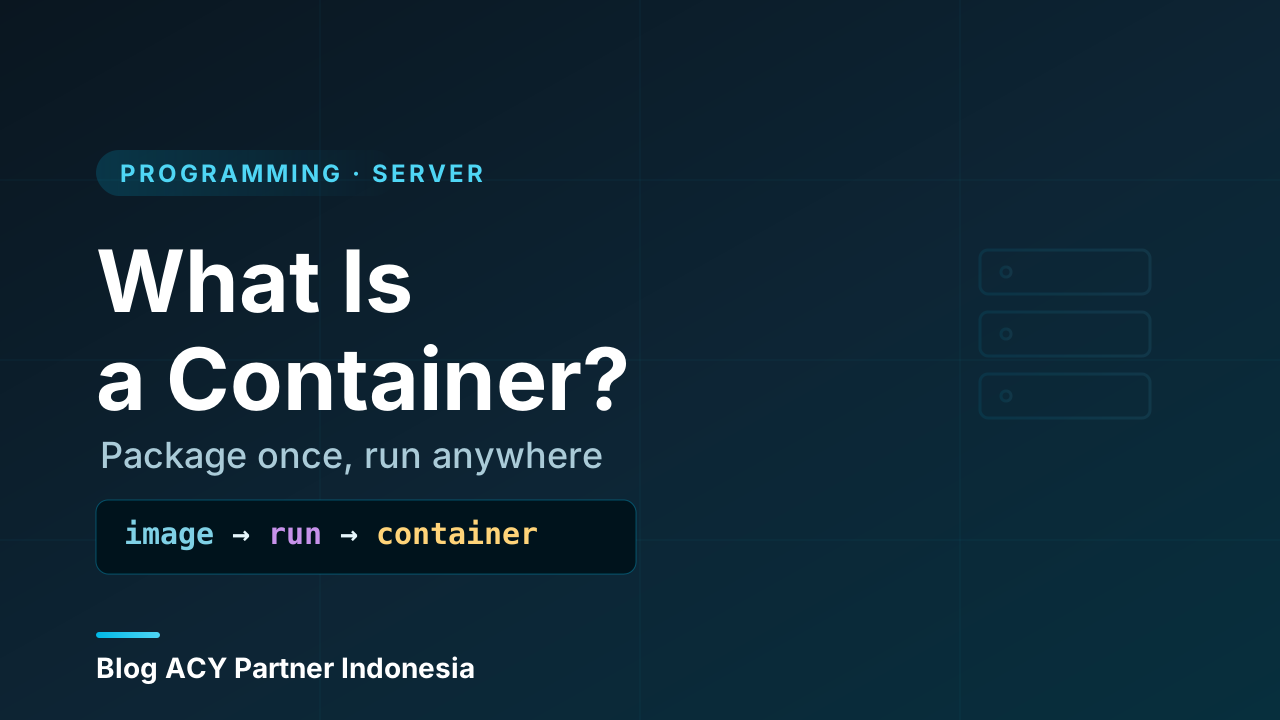
An image is the blueprint — a frozen, read-only template that describes exactly what should be in the box: the app, the dependencies, the configuration. It’s a file you can store, copy, and share. Nothing runs from an image directly; it just sits there as a definition.
A container is what you get when you run an image. It’s the live, running instance — the box brought to life. From a single image you can start one container, or a hundred identical ones, and each is its own running copy.
   IMAGE  ──(run it)──►  CONTAINER
   (blueprint,            (running instance,
    read-only)            live, isolated)
The mental model is like a class and an object in programming, or a recipe and the actual meal. One is the static definition; the other is the thing actually doing work. Keep them straight and a lot of container vocabulary stops being confusing.
Why 'it works on my machine' finally dies
Because the image carries the exact dependencies, the version running on a developer’s laptop is the same image that runs in testing and the same image that runs in production. There’s no “but the server has a different library version” anymore, because the library version travels inside the box. When something works in one place, it works everywhere — and when it breaks, it breaks the same way everywhere, which makes it far easier to fix.
Where containers fit into the bigger picture
It’s worth being clear about what a container does and doesn’t change. A container is a packaging and isolation technology. It doesn’t replace your server — it runs on one. You still need a machine (or many) somewhere to run your containers, the same way you always needed a place for your software to live. If the very idea of a server is still hazy, start with what a server actually is and come back; this all stacks on top of that foundation.
What containers change is how software gets bundled and moved. Instead of writing pages of setup instructions (“install this version, then that library, then edit this config file”) and hoping each server matches, you build one image and run it. That single shift is why containers became the backbone of modern deployment, microservices, and the tooling that automatically scales apps up and down with demand. They’re the standard unit that all of that machinery is built to move around.
You don’t need to memorize any of that yet. The one idea to hold onto is the box: an application sealed up with everything it needs, isolated, portable, and identical wherever it runs.
Wrapping up
Here’s the whole idea in one place:
- A container packages an app together with all its dependencies — code, runtime, libraries, settings — into one isolated, portable unit.
- It solves the “works on my machine” problem by carrying its dependencies inside the box, so the app runs the same everywhere.
- A container is not a virtual machine: it shares the host’s operating-system kernel instead of booting its own, which makes it small and fast to start.
- From the host’s side, a container is just a tightly isolated process; from the inside, it looks like its own clean machine.
- An image is the read-only blueprint; a container is a running instance of that image — like a recipe versus the finished meal.
- Containers don’t replace servers; they’re a standard way to package and move software that runs on top of them.
Next, it’s worth zooming in on the comparison everyone bumps into early: how a container differs from a virtual machine, and why that difference decides which one you reach for.