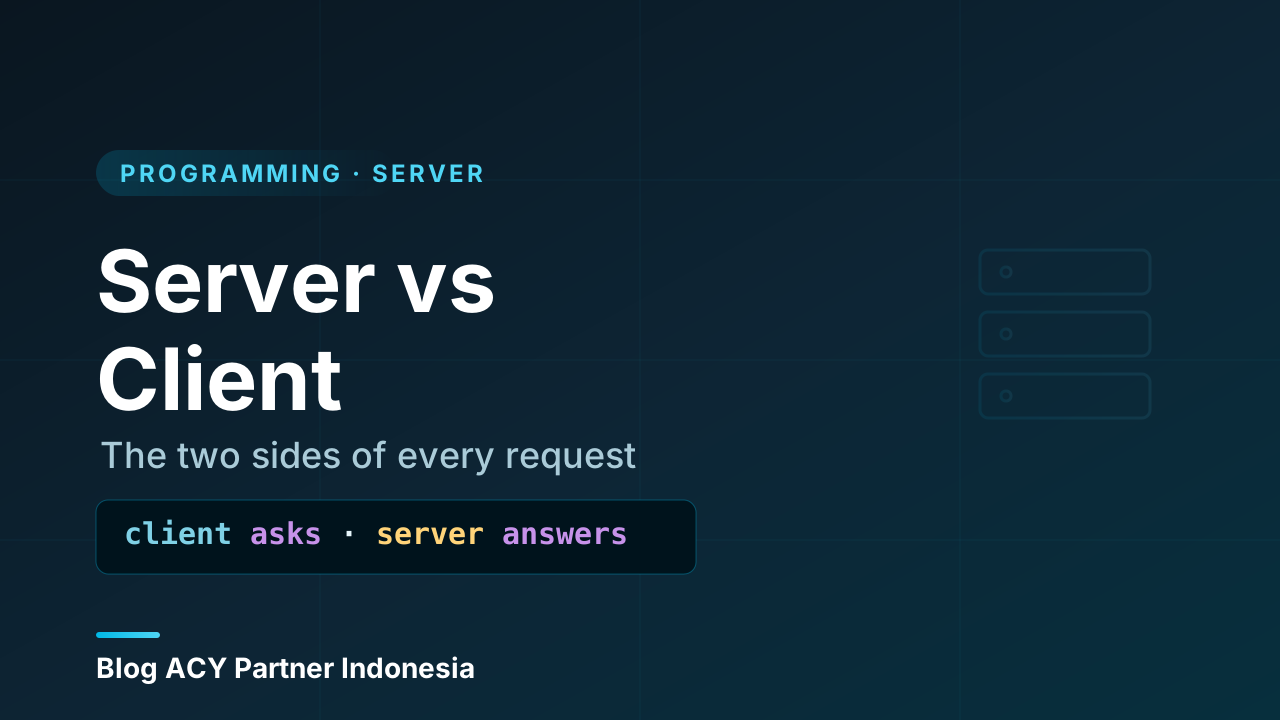
If you’ve spent any time around web development, you’ve heard the words server and client thrown around constantly — usually in the same sentence, often without anyone stopping to explain how they relate. They’re not two competing things. They’re two roles in a single conversation, and almost every action you take online is one of these conversations playing out.
Once you can look at any feature and instantly tell which part runs on the client and which part runs on the server, a lot of things get easier: bugs become predictable, security decisions become obvious, and tutorials stop sounding like riddles. So let’s pin down both sides clearly, with no hand-waving.
What a client is
A client is whatever asks for something. It starts the conversation. When you open a web page, your browser is the client — it sends out a request saying “give me this page,” and then it waits. A mobile app is a client too. So is a desktop program that checks for updates, or a command-line tool that downloads a file. Anything that initiates a request and consumes the response is playing the client role.
The defining trait of a client is that it reaches out. It knows where to find the thing it wants (an address) and it knows how to ask (a protocol). Beyond that, a client is usually focused on one user at a time — you. Your browser serves you and nobody else. That’s a big part of what separates it from a server.
What a server is
A server is whatever waits to be asked, then answers. It doesn’t start the conversation; it sits there, listening, ready to respond when a request arrives. When your browser asks for a page, some machine on the other end receives that request, works out what’s needed, and sends back a response. That machine — and the program on it that handles the request — is the server.
The defining trait of a server is that it listens and responds, often to many clients at once. A single server might be answering thousands of requests per second from people scattered all over the world, all in the same moment. If the idea of a server as a whole is still fuzzy, it’s worth backing up to what a server actually is first — this article assumes you’ve got that basic picture and zooms in on how it contrasts with the client.
Client and server are roles, not machines
The same physical computer can be a client in one conversation and a server in another. A web server that needs data might turn around and act as a client to a database server — it sends a request and waits for an answer. So don’t think “client = laptop, server = big machine in a rack.” Think “client = the side asking, server = the side answering.” The roles can swap depending on which way a particular request is flowing.
The request and response
Everything between a client and a server happens as a back-and-forth of requests and responses. The client sends a request — “I want the homepage,” “save this form,” “log me in.” The server receives it, does whatever the request calls for, and sends back a response — the page, a confirmation, an error, some data. Then the conversation is done, and the next one starts fresh.
   CLIENT                              SERVER
 (asks first)                       (answers)
     │                                  │
     │   request  ──────────────────►   │
     │                                  │  do the work
     │   ◄──────────────────  response  │
     │                                  │
  uses the result
Picture ordering food at a counter. You (the client) walk up and place an order. The kitchen (the server) takes it, prepares the dish, and hands it back. You don’t cook; the kitchen doesn’t decide what you’re hungry for. Each side has a clear job, and the order ticket is the request, the plate is the response. The web works the same way, just millions of times a second.
Where your code actually runs
Here’s where this distinction stops being trivia and starts mattering to you as a builder. In a typical web app, your code is split across both sides, and which side a piece of code runs on changes everything about it.
Client-side code runs in the user’s browser, on the user’s device. This is your HTML, CSS, and the JavaScript that handles clicks, animations, form validation as you type, and updating the page without a reload. It runs on whatever phone or laptop the visitor happens to have, using their battery and their network.
Server-side code runs on the server, on hardware you control. This is the logic that checks passwords, reads and writes the database, processes payments, and decides what data a given user is allowed to see. It runs in a controlled environment, the same way every time, no matter what device the visitor is using.
  BROWSER (client side)            SERVER (server side)
  ─────────────────────            ────────────────────
  • HTML / CSS layout              • authentication
  • UI interactions                • database reads/writes
  • form typing feedback           • business rules
  • client-side validation         • payments, secrets
  • runs on the USER's device      • runs on YOUR machine
The line between these two is one of the most important lines in all of web development. A lot of beginner confusion — and a lot of real security holes — come from putting something on the wrong side of it.
Never trust the client
Anything that runs on the client can be seen, changed, or faked by the user. Browser dev tools let anyone read your client-side JavaScript and edit the request before it’s sent. So validation you do in the browser is for convenience (instant feedback), never for security. If a rule actually matters — “only the account owner can delete this,” “the price is $20, not $0” — it has to be enforced on the server, where the user can’t tamper with it. “Validate on the client for UX, enforce on the server for safety” is a rule worth tattooing on your brain.
Why the split exists at all
You might wonder why we bother splitting work across two sides instead of doing everything in one place. The split exists because each side is good at different things.
The client is close to the user, so it’s perfect for anything that needs to feel instant — showing a menu when you hover, validating a field as you type, animating a transition. Doing that on the server would mean a slow round trip across the network for every tiny interaction.
The server is the one place everyone shares, and the one place you control, so it’s where anything trustworthy or shared has to live. Your data, the rules of your app, the secret keys, the source of truth — all of it sits on the server because it must be the same for everyone and protected from tampering. The client can’t be trusted with secrets, because the client belongs to the user, not to you.
So the division of labor is natural: the client handles presentation and immediate interaction, the server handles truth and trust. Good apps put each kind of work where it belongs.
A worked example
Imagine Jane Doe logs into her account on a site built by ACY Partner Indonesia. Watch how the roles play out:
- Jane types her email and password into a form. The client (her browser) gives instant feedback if the email is missing an
@. That’s a convenience check, nothing more. - She clicks “Log in.” The client packages up the email and password and sends them as a request to the server.
- The server receives the request. It looks up Jane’s account, checks the password against the stored (hashed) one, and decides whether she’s allowed in. This is the real security check, and it happens where Jane can’t fake the answer.
- The server sends back a response — a success, along with a token proving she’s logged in, or an error if the password was wrong.
- The client receives the response and updates the page: it shows Jane’s dashboard, or shows the error message.
Every step is either “client asking” or “server answering.” Notice that the important decision — is this really Jane, and is the password correct — happens entirely on the server. The client’s job was to collect input and display the result, which is exactly what the client should do.
Common points of confusion
A few things trip people up when they’re learning this, so let’s clear them out:
- “Frontend” and “backend” aren’t quite the same as client and server, but they’re close. Frontend is the client-side part you see and interact with; backend is the server-side part that handles data and logic. People use the terms almost interchangeably, and that’s usually fine.
- A server can be a client too. As mentioned, your web server often acts as a client to a database or another service. Roles depend on the direction of the request, not on the machine.
- “Serverless” still uses servers. It’s a marketing-ish name for a setup where you don’t manage the servers yourself — the provider runs them for you and spins them up on demand. There’s still a server answering requests; you just don’t babysit it.
- The client isn’t always a browser. Mobile apps, smart TVs, other servers, scripts, and IoT devices are all clients when they make requests. The browser is just the most familiar example.
Why this matters for you
Getting comfortable with the client–server split pays off immediately. When a feature misbehaves, your first useful question becomes “is this a client problem or a server problem?” — and that single question cuts the search space in half. When you’re deciding where to put a piece of logic, you’ll instinctively ask “does this need to be trusted? then it goes on the server.” When you read documentation or tutorials, phrases like “do this client-side” or “handle it on the server” will read like plain instructions instead of jargon.
This mental model is the lens you’ll use for the rest of your time building things that run online. Almost every later topic — hosting, networking, security, deployment — is really about making one side or the other do its job well.
Wrapping up
Here’s the whole picture in one place:
- A client is the side that asks first — your browser, a mobile app, a script. It initiates the request and uses the response.
- A server is the side that waits and answers, usually serving many clients at once.
- Client and server are roles, not specific machines — the same computer can play either role depending on which way a request is flowing.
- Every interaction is a request (client → server) and a response (server → client).
- Client-side code runs in the user’s browser and is great for instant, interactive things — but it can never be trusted. Server-side code runs on hardware you control and is where truth, data, and security must live.
- The golden rule: validate on the client for a smooth experience, enforce on the server for safety.
Next, it helps to widen the view and look at the different types of servers you’ll meet — web, application, database, and more — because each one is a server playing a slightly different role in the same client–server dance.