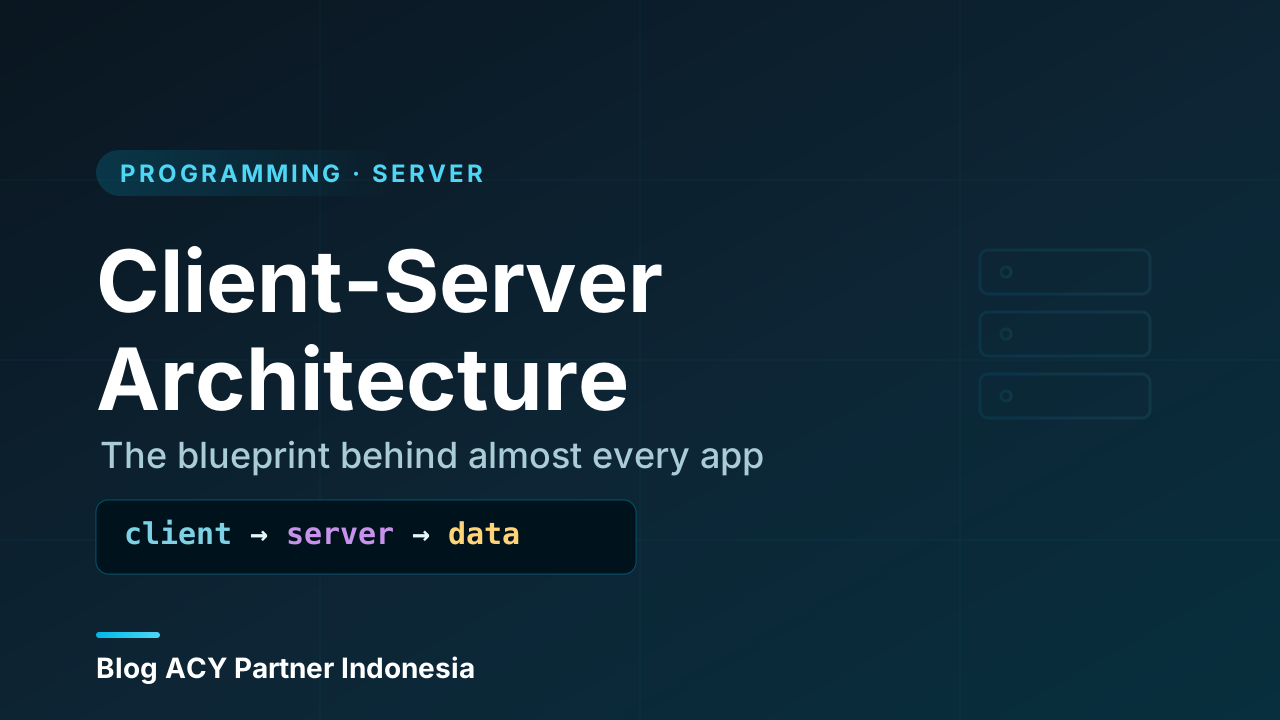
By now you’ve met the server and the client as individual ideas. Client-server architecture is what you get when you zoom out and look at how those two roles are wired together into a whole system. It’s not a new piece of technology — it’s a pattern, a way of organizing software so that one set of machines asks for things and another set provides them. And it’s the single most common shape in all of computing: your email, your banking app, this very blog, multiplayer games, smart home devices — almost all of it follows this blueprint.
The reason it’s worth studying as an architecture, and not just as “a client and a server talking,” is that the way you arrange these pieces decides how your app scales, how secure it is, how easy it is to change, and how much it costs to run. Get the shape right and growth feels natural. Get it wrong and you fight your own system every step of the way. So let’s look at the blueprint properly.
What “architecture” means here
When people say architecture in software, they mean the big-picture structure: which parts exist, what each part is responsible for, and how the parts talk to each other. It’s the floor plan, not the furniture. You can swap out the database, rewrite the frontend, or change programming languages, and the architecture can stay the same as long as the overall shape holds.
Client-server architecture, specifically, is the floor plan where responsibilities are divided between two kinds of participants. Clients request services. A server (or a group of servers) provides them. Clients don’t talk directly to each other for the core work — they go through the server, which acts as the shared, central point everyone connects to. If you’ve read about the difference between a server and a client, this is that same relationship, drawn at the scale of an entire system instead of a single exchange.
The opposite arrangement is worth naming for contrast: peer-to-peer, where every machine is both client and server at once and they talk directly, with no central authority. File-sharing networks and some blockchains work that way. It has its uses, but it’s harder to control, secure, and reason about — which is exactly why the centralized client-server shape dominates the everyday web.
The basic two-party model
The simplest version of the architecture has just two participants. Many clients, one server, all connecting over a network.
   client A ─┐
             │
   client B ─┼──────────►  ┌──────────┐
             │  requests   │  SERVER  │
   client C ─┤  ◄──────────│          │
             │  responses  └──────────┘
   client D ─┘
Each client opens its own conversation with the server, sends a request, and gets a response back. The server has no idea the clients exist until they reach out, and it usually doesn’t remember much about them between requests — each request is handled on its own. This independence is what lets a single server juggle thousands of clients at the same time: it’s not maintaining thousands of ongoing relationships, just answering one request after another as they arrive.
The server in this picture is the center of gravity. It holds the shared data, enforces the rules, and is the one thing every client depends on. That centralization is the whole point — it gives you a single source of truth that everyone agrees on — but it’s also the part you have to protect and scale most carefully, because if the server goes down, every client is stranded.
One logical server, many physical machines
When we draw “the server” as a single box, that’s the logical view. In real systems, that one box is very often many machines working together behind the scenes — several copies of your app sharing the load, a separate database, a cache, and so on. To the client it still looks and behaves like one server at one address. Keeping that illusion of “one server” while spreading the actual work across many machines is a huge part of what scaling is about.
Why apps get split into tiers
The two-party model is a fine starting point, but real applications quickly grow a third concern: where does the data live, and who is allowed to touch it? This is where the architecture grows layers, usually described as tiers. The most common arrangement is the three-tier architecture, and it shows up so often that it’s worth knowing by name.
  ┌──────────────┐    ┌──────────────┐    ┌──────────────┐
  │ PRESENTATION │    │ APPLICATION  │    │     DATA     │
  │    tier      │    │     tier     │    │     tier     │
  │              │    │              │    │              │
  │ what the     │◄──►│ the logic    │◄──►│ where info   │
  │ user sees +  │    │ and rules of │    │ is stored    │
  │ interacts    │    │ the app      │    │ and queried  │
  │ with         │    │              │    │              │
  └──────────────┘    └──────────────┘    └──────────────┘
    client side          server side         server side
   (browser, app)      (your code runs)     (the database)
Here’s what each tier is responsible for:
- Presentation tier — the part the user sees and touches. The web page, the buttons, the mobile app screen. This is the client side: it collects input and displays results, but it doesn’t hold the real data or make the real decisions.
- Application tier — the brains. This is your server-side code: the logic that checks permissions, applies business rules, processes a payment, decides what a user is allowed to see. It sits between the user and the data, and nothing reaches the data without going through it.
- Data tier — where information actually lives, usually a database. It stores and retrieves data but doesn’t decide who’s allowed to ask for what — that’s the application tier’s job.
Splitting the work this way pays off in a dozen quiet ways. You can redesign the entire look of the app (presentation tier) without touching the rules or the data. You can swap the database (data tier) without rewriting the user interface. You can put each tier on its own machine and scale them independently — add more application servers when traffic spikes, give the database its own powerful hardware. The separation turns one big tangled thing into three smaller, replaceable things.
The tiers are about responsibility, not necessarily separate machines
A three-tier architecture doesn’t require three physical computers. On a small project, all three tiers might run on a single server — your app code and your database side by side on one machine. “Three-tier” describes how the responsibilities are separated in your design, not how many boxes you’ve rented. The benefit is that because the layers are kept logically distinct, you can later move them onto separate machines as you grow, without rewriting everything.
A request flowing through the tiers
Patterns sink in faster with a concrete example, so let’s trace a single action through a three-tier setup. Say Jane Doe opens her order history on a shop built by ACY Partner Indonesia.
- Jane clicks “My Orders.” The presentation tier (her browser) sends a request to the server: “give me Jane’s orders.” It doesn’t know how orders are stored or where — it just knows the address to ask.
- The application tier receives the request. First it checks: is this really Jane, and is she allowed to see these orders? Only after that check passes does it decide what to fetch. This is the gatekeeping that has to happen on the server, because the client can’t be trusted to police itself.
- The application tier asks the data tier: “fetch the orders belonging to Jane’s account.” The database runs the query and hands back the rows. It doesn’t second-guess the request — it trusts that the application tier already did the security check.
- The application tier takes the raw data, shapes it into a tidy response (maybe formatting dates, hiding internal fields), and sends it back across the network.
- The presentation tier receives the response and renders it — a clean list of Jane’s past orders on her screen.
Notice how each tier stuck to its lane. The browser displayed; the application logic decided and guarded; the database stored and retrieved. No tier did another tier’s job. That discipline is what keeps a growing app understandable instead of turning into a knot where everything touches everything.
How this architecture scales
The real reason client-server architecture has lasted for decades is that it scales gracefully. Because clients are independent and the server is centralized, you have clear places to add capacity when more users show up.
The first move is usually to run more than one server behind a single address, with a piece in front that spreads incoming requests across them. To the client nothing changes — it still talks to “the server” at one address — but behind the scenes the work is shared by a fleet of machines. Add machines, handle more traffic. This works precisely because the architecture already separated the client from the server: the client never assumed it was talking to one specific machine.
The data tier scales differently and is usually the trickier part, since there’s pressure to keep a single source of truth even as you add copies for speed and safety. But the principle holds: each tier can grow on its own terms. You can throw application servers at a traffic spike while leaving the database alone, or beef up the database without touching your app code. The architecture gives you independent knobs to turn instead of one giant lever.
Centralization is a strength and a weakness
The central server is what makes client-server architecture simple to reason about — one source of truth, one place to enforce the rules. But it’s also a single point of failure: if that center goes down and you’ve made no backup plan, every client is cut off at once. This is why serious systems run multiple servers, keep database backups, and design so that the loss of any one machine doesn’t take the whole service with it. The convenience of a center comes with the duty to make that center resilient.
Where this fits with everything else
Client-server architecture is the frame that the rest of the server world hangs on. The different types of servers you’ve read about — web, application, database — are really just the application and data tiers, each specialized for its job. How a server handles a request is the inside view of one box in these diagrams. Hosting, networking, deployment, and security — every topic that comes later is, in some way, about making one tier of this architecture do its job well and reliably.
That’s why it pays to carry this mental model with you. When you read about a new tool or technique, you can usually place it: is this about the presentation tier, the application tier, or the data tier? Is it helping clients reach the server, or helping the server handle more clients? Slotting new ideas into a structure you already understand is far easier than meeting each one cold.
Wrapping up
Here’s the blueprint in one place:
- Client-server architecture is a pattern that organizes a system into clients that request services and a server (or servers) that provides them, with the server as the shared, central point everyone connects to.
- The simplest form is two-party: many independent clients, one logical server. Independence is what lets one server handle a crowd.
- Real apps grow into tiers — most commonly the three-tier split of presentation (client side), application (server-side logic), and data (the database) — so responsibilities stay separate and replaceable.
- Each request flows through the tiers in order, with each tier sticking to its own job: display, decide and guard, store and retrieve.
- The architecture scales by adding capacity to tiers independently — more application servers, a stronger database — without the client ever needing to know.
- Centralization gives you a single source of truth, but the center must be made resilient, or it becomes a single point of failure.
With the blueprint in hand, the natural next step is to look beneath it — at the network the clients and server actually talk over, and the addresses, protocols, and machinery that carry every request and response from one side to the other.