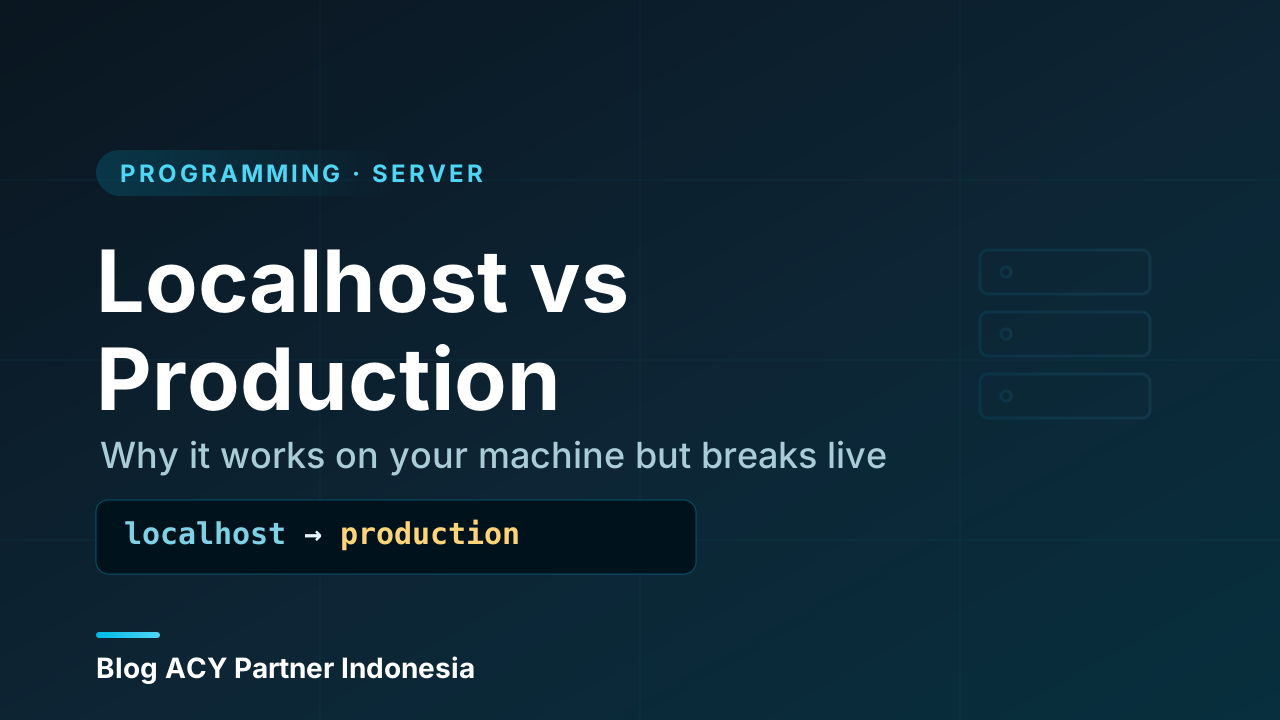
There’s a phrase every developer says at least once, usually through gritted teeth: “but it works on my machine.” The code ran perfectly five minutes ago on your laptop, and now it’s live and something is broken. Nobody changed the code. So what happened?
The answer is almost always the gap between localhost and production — two environments that run the same code but live in very different worlds. Once you understand what actually separates them, that frustrating phrase stops being a mystery and starts being a checklist. This is one of the most useful ideas to get straight early, because every project you ever ship crosses this divide.
What “localhost” really means
When you build something on your own computer and open it in your browser at an address like http://localhost:3000, you’re talking to a server — it’s just that the server is your own machine. Localhost literally means “this computer here.” It’s a special name that always points back to the machine you’re sitting at.
You may have already met this idea: running your project locally means your laptop is temporarily playing the server role, answering requests from your own browser and nobody else’s. If that’s still fuzzy, it’s worth a quick detour through what a server actually is before going further — the rest of this article builds right on top of it.
The key trait of localhost is isolation. The app is reachable only from your computer. No one else on the internet can open it. There’s no real domain name, no other users, no traffic but your own clicks. It’s a private sandbox where you can break things, restart constantly, and nobody notices.
   LOCALHOST                          PRODUCTION
 (your laptop)                     (a server online)

  only you can reach it            the whole world reaches it
  http://localhost:3000            https://example.com
  restart whenever                 must stay up 24/7
  test data                        real users' real data
  errors only you see              errors everyone sees
What “production” really means
Production is the live version of your app — the one real users actually use. It runs on a server that’s always online, reachable through a real domain name, serving real people doing real things. The word comes from the idea that this is the environment “in production use,” as opposed to one you’re still tinkering with.
Production is the opposite of isolated. It’s public, shared, and unforgiving. If it goes down, people notice immediately. If it’s slow, people leave. If it loses data, that data might be gone for good. Everything you could shrug off on localhost suddenly matters.
This is why the journey of your code from your laptop to a live server — a process called deployment — gets so much attention. It’s not just copying files. It’s moving your app into an environment with completely different rules.
They're 'environments,' and there are often more than two
Localhost and production are both examples of environments — distinct setups where your code runs. Many teams add a third in the middle called staging: a near-copy of production used to test changes safely before real users see them. You’ll also hear “development” (your local setup) and “test” (where automated tests run). The exact number varies by team, but the core split is always the same: a private place to build, and a public place that’s live. Everything else sits somewhere on that spectrum.
Why the same code behaves differently
Here’s the part that trips everyone up. The code is identical, so why does behavior change? Because code is only half of what runs an app. The other half is everything around the code — and that “everything” is different between your laptop and the server. These differences are the real reason “it works on my machine” happens.
The operating system and installed software differ
Your laptop might run Windows or macOS. The production server almost always runs Linux. The versions of the language runtime, the database, and the dozens of small libraries underneath your app can all differ between the two. A feature that exists in the version on your machine might be missing or behave differently in the version on the server.
Configuration is different
Apps rarely hardcode everything. They read settings from the environment — things like which database to connect to, what secret keys to use, whether to show detailed errors. On localhost you point at a local test database; in production you point at the real one. If a setting is missing or wrong on the server, the app breaks even though the code is fine.
# On localhost, you might set:
DATABASE_URL=localhost:5432/myapp_dev
DEBUG=true

# In production, the same app reads different values:
DATABASE_URL=db.internal.example.com:5432/myapp
DEBUG=false
The network and addresses are different
On localhost everything is reachable at localhost and a port number. In production, services live at real domain names or internal network addresses, behind firewalls, with HTTPS instead of plain HTTP. Code that assumes “the database is right here on this machine” falls apart the moment the database lives somewhere else.
Scale and data are different
On your machine you’re the only user, with a handful of fake records. Production might face thousands of users and millions of real rows. Something that felt instant with 10 test items can crawl with a real dataset. Bugs that only appear under load, or with messy real-world data, simply can’t show up in your quiet local sandbox.
The classic trap: missing dependencies and config
The most common reason a deploy breaks is something that only existed on your machine. A library you installed globally and forgot about. An environment variable you set once in your terminal months ago. A file sitting in a folder you never committed. On your laptop it’s all there, so everything works. The server is a clean slate — if it isn’t explicitly set up or committed to your project, it simply isn’t there. When a deploy fails, “what does my machine have that the server doesn’t?” is the first question to ask.
A mental model that keeps you out of trouble
The healthiest way to think about it: localhost is a rehearsal, production is the live show. A rehearsal lets you stumble, restart, and try things with no audience. The live show has an audience, a fixed stage you didn’t build yourself, and no second takes for the people watching. The script (your code) is the same — but everything around the performance is different, and that’s exactly where surprises come from.
A few habits flow naturally from this:
- Keep your environments as similar as you reasonably can. The closer your local setup matches production — same language version, same database type, same configuration approach — the fewer surprises at deploy time. This is the whole reason tools that “package up” an app to run identically everywhere became popular.
- Never hardcode anything that changes between environments. Database addresses, secret keys, feature flags — read them from configuration, not from code. Then each environment can supply its own values.
- Treat production as something you don’t poke at directly. On localhost you experiment freely. On production you make deliberate, tested changes. Big difference in mindset.
- Assume the server has nothing until you put it there. Every dependency, every config value, every file your app needs has to be explicitly part of what you deploy — not just sitting on your laptop by accident.
Why this distinction matters
Understanding localhost versus production reframes a whole class of problems. “It works on my machine” stops being a curse and becomes a question with a finite list of answers: the OS differs, a dependency is missing, a config value is wrong, the data is bigger, the network is different. You stop being baffled and start being methodical.
It also sets up everything that comes later in working with servers. Deployment, environment configuration, staging environments, monitoring, logging — all of them exist precisely because the place your code runs live is not the place you wrote it. Get this divide clear in your head now, and the entire workflow of shipping software starts to make sense as one connected story instead of a pile of disconnected steps.
Wrapping up
Here’s the whole idea in one place:
- Localhost is your app running on your own machine — private, isolated, reachable only by you, safe to break and restart.
- Production is your app running live on a server — public, shared, always-on, serving real users with real data and real consequences.
- Both are environments, and teams often add staging in between as a safe rehearsal of production.
- The same code can behave differently because everything around the code differs: the operating system, installed versions, configuration, network, scale, and data.
- “It works on my machine” almost always means something existed locally that isn’t set up on the server — a missing dependency, a wrong config value, or untracked file.
- Keeping environments similar, never hardcoding environment-specific values, and treating production with care are the habits that prevent most surprises.
Next, it helps to zoom into how machines actually find and talk to each other across these environments — starting with IP addresses and ports, the numbers that make “where does this request go?” a concrete, answerable question.